
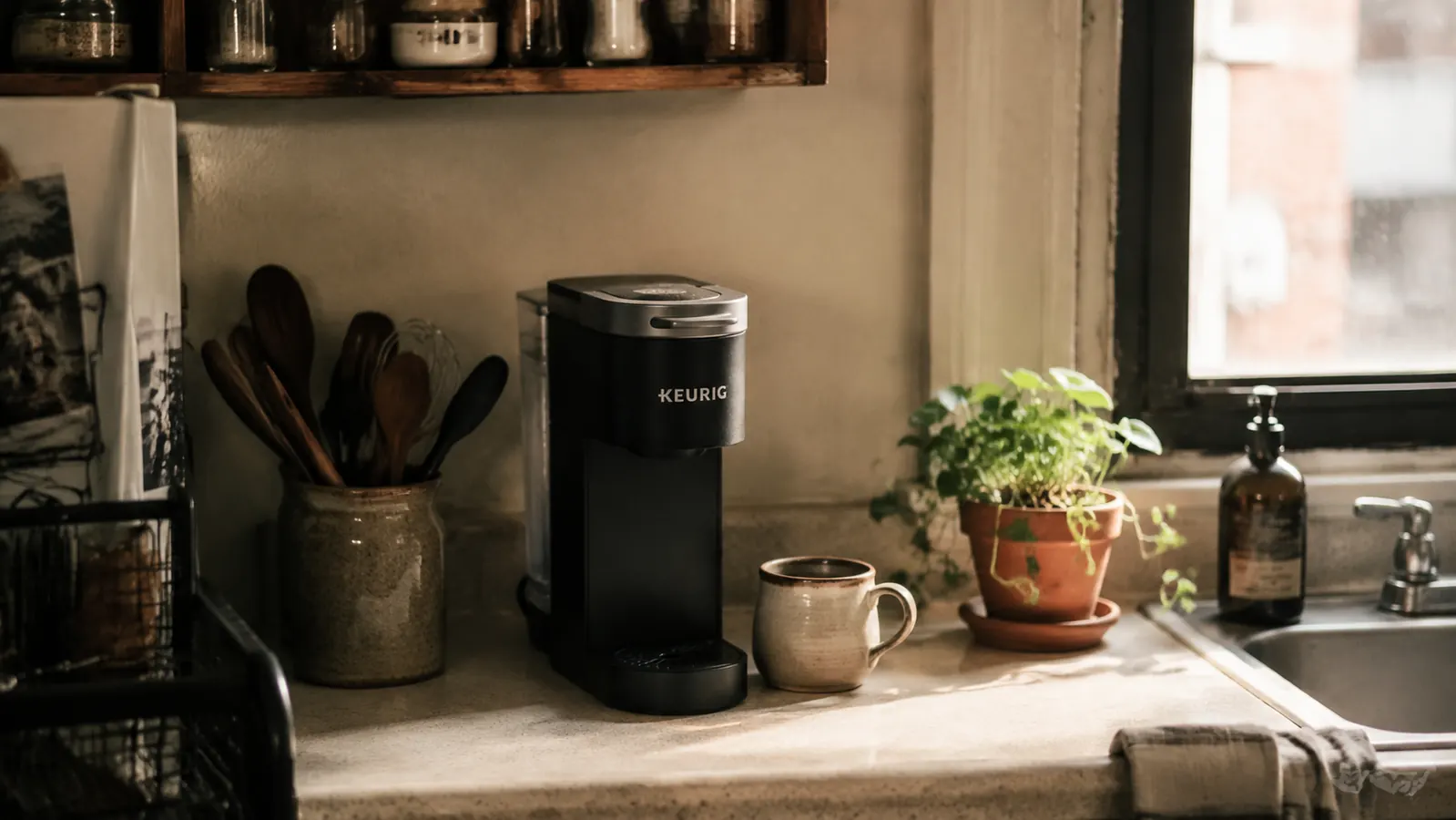
Let me tell you the thing that surprised me most about the Keurig K-Mini: it is not a bad coffee maker. It is actually a pretty good one, within a very specific set of conditions that the listing never quite spells out. The problem is that a lot of people buy it expecting one thing and get another, then write a glowing five-star review because they adjusted their expectations rather than because their expectations were met. I want to give you the version before the adjustment.
The K-Mini has 4.3 stars across 107,989 reviews on Amazon as of this writing. That is genuinely impressive. But scroll the one- and two-star reviews and you will see the same complaints surfacing over and over, the same things that never make the highlight reel: you have to refill the water every single cup, the pods add up to a lot of money faster than most people realize, the brew temperature is lower than many people want, and the second a friend comes over for coffee you are suddenly running a very slow single-cup assembly line. None of that makes it a bad product. But it might make it the wrong product for you specifically, and that is worth knowing before you spend the money.
The Quick Verdict
A genuinely convenient single-serve machine for true solo drinkers, but the pod cost, fill-every-cup reservoir, and lukewarm brew temp are real limitations that the star rating quietly glosses over.
Amazon Check Today's Price →Still the right fit for a lot of solo brewers -- see today's price before you decide
The K-Mini earns its spot in small kitchens for the right person. Check the current price and see if it is in stock before reading the full breakdown below.
Amazon Check Today's Price on Amazon →How I Tested This
I borrowed a K-Mini from my neighbor Theresa, who bought it for her new apartment last fall, used it about three times, and then slid it to the back of her counter. She still liked it, she said, but she had stopped reaching for it. That was more interesting to me than any online review. I used it in my own kitchen for six weeks, tracking pods per week, water fill time per cup, and how often I noticed the coffee temperature felt off. I also ran it through a descaling cycle, because the machine actually reminded me to and I wanted to see what that process looked like.
I tried seven different K-Cup brands across the testing period, from the Keurig-branded pods to a grocery store generic, a Dunkin pod, two light roasts, and a medium-bold blend. I tracked how each tasted at the 6-oz, 8-oz, and 12-oz brew settings. My baseline is two cups of coffee most mornings, medium strength, nothing fancy. I am not a barista. I am not a coffee snob. I just want hot coffee that tastes like coffee, and I want to know whether this machine reliably delivers that.
The No-Reservoir Reality Nobody Warns You About
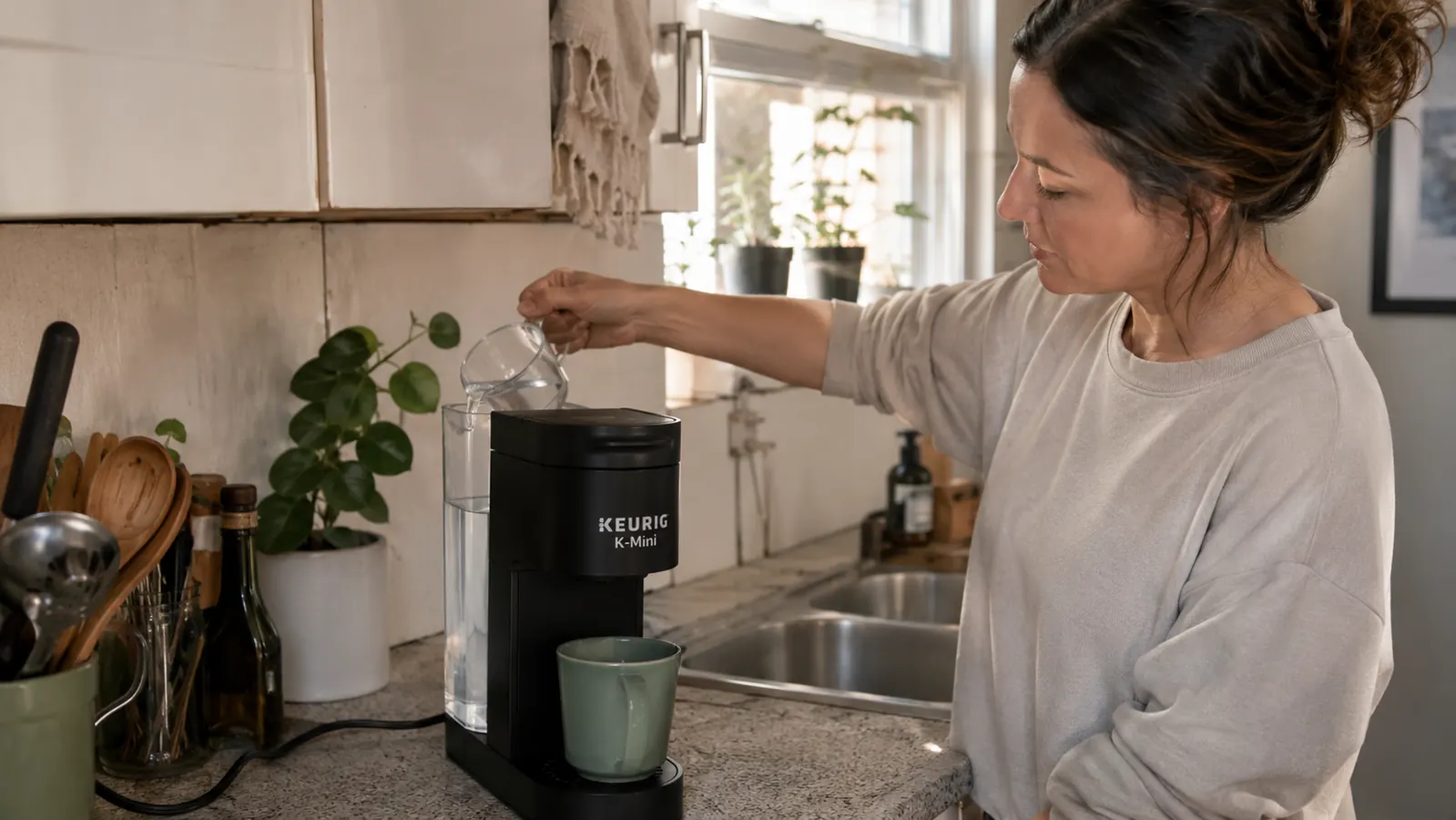
Here is the thing that should be in the headline but never is: the Keurig K-Mini does not have a water reservoir you fill once and forget. You fill it before every single cup. The water chamber holds exactly enough for one brew, 6 to 12 ounces, and then it is empty. Every morning. Every cup. Every time.
For a truly solo drinker who makes one cup and walks away, this is not a big deal at all. You fill it, you brew, you go about your morning. Fine. But if you drink two cups back-to-back the way I do, that means two fills, two waits for the machine to heat, two rounds of the full brew sequence. The machine takes about two minutes to heat up and brew. So two cups is realistically a four-to-five-minute process, not two. Compare that to making a pot of pour-over or drip coffee, where you fill once and pour twice, and the arithmetic starts to feel less convenient.
Most reviews skip this because people adjust their behavior without noticing. They just start making one cup instead of two. That is fine, but you should know going in that the K-Mini is designed for one-cup people. If you are a two-cup person, you will either adapt or feel quietly annoyed every morning.
The Pod Cost Math, Done Out Loud
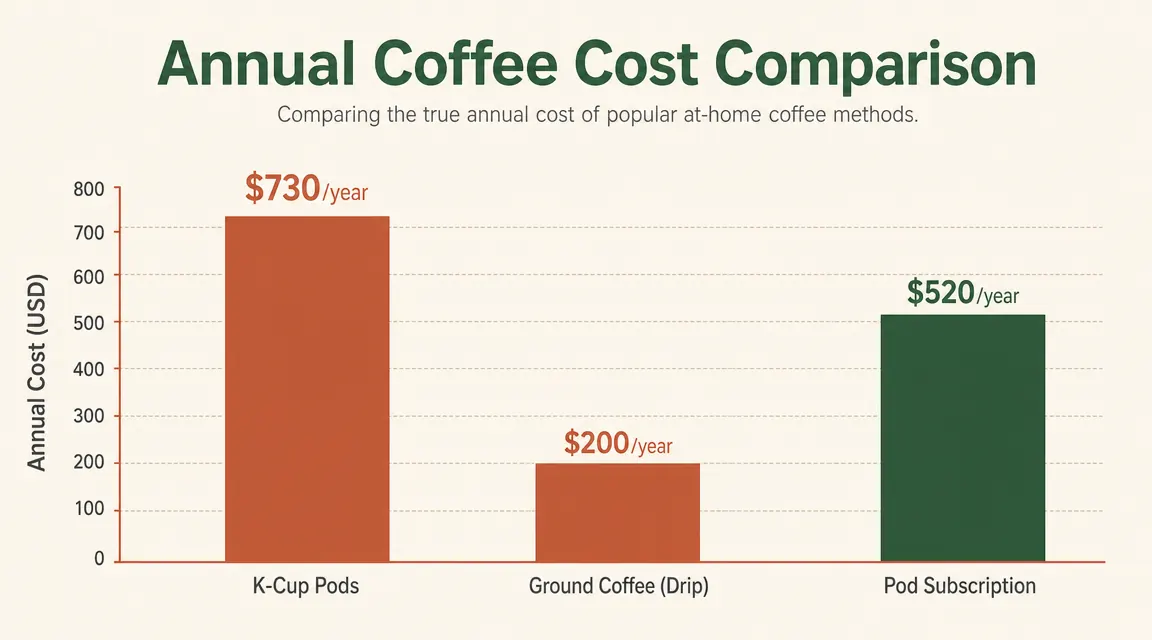
K-Cups on Amazon run roughly $0.50 to $0.75 per pod for major brands, sometimes a bit less for store generics, sometimes more for specialty roasts. Let us say you average $0.60 a pod, which is realistic for mid-tier branded pods bought in bulk. At one cup a day, that is $219 a year. At two cups a day, that is $438. At two cups a day with a slightly nicer pod, you are easily over $500 annually.
A bag of decent ground coffee for a drip machine or a French press runs at typical grocery pricing and makes roughly 30 to 40 cups. That same two-cups-a-day habit costs somewhere in the low hundreds a year, total, for the same number of cups. The pods cost more than double the equivalent ground coffee. This is not news, but it is a number most people have not done out loud before they buy. The machine itself is moderately priced. If you drink one pod a day, you will spend more on pods in one year than you spent on the machine. In two years, the pods cost three to four times the machine.
The K-Mini itself is a modest purchase. The pods are a significant per-year commitment. Make sure you are signing up for both.
You can use a reusable K-Cup filter to run ground coffee through it, and that does fix the cost problem. The My K-Cup Universal Reusable Filter costs very little and works in the K-Mini. If you go that route, the machine makes a lot more sense financially. But most people buy a Keurig specifically to avoid the mess of ground coffee, and if you add the reusable filter back in, you have basically turned it into a drip coffee maker with extra steps.
Brew Temperature: Not Quite Right for Strong Coffee
The K-Mini brews at around 192 degrees Fahrenheit. The specialty coffee standard for optimal extraction is 195 to 205 degrees. That three-to-thirteen-degree gap does not sound like much, but it is noticeable in the cup, especially at the 10-oz and 12-oz brew settings. The larger the cup size, the more diluted the flavor gets, because the pod has the same amount of coffee grounds no matter what size you select. Brewing at 12 oz with a medium roast pod often produces coffee that tastes weak and slightly flat.
At 6 oz, the brew is noticeably more concentrated and better tasting. At 8 oz, it is decent. At 12 oz, it often tastes like the last few ounces of a pot that has been sitting on a burner too long. If you are a person who drinks a full large mug of coffee, the K-Mini may consistently disappoint you, because the pod format does not scale the way a full pot does.
Strong-coffee people, bold-roast people, anyone who wants something close to espresso concentration: this machine is not going to get you there. Keurig makes other machines with stronger brew settings. The K-Mini does not have that option. You get one temperature and three cup sizes, and that is the entire menu.
When a Guest Comes Over
The single-serve format is a real social limitation that almost no review bothers to mention, probably because most reviewers are writing about their solo-use experience and not thinking about the Friday morning their sister visits. I had two people over for coffee on a Saturday during my testing period. Making three cups of coffee took about fifteen minutes from first fill to third cup ready. Fifteen minutes is a long time to stand in a kitchen while people are waiting. It felt less like making coffee and more like operating a very polite little machine at its own pace.
This is not a fatal flaw if you live alone and rarely have guests. It is a meaningful limitation if you have a partner, a roommate, or any kind of regular morning routine that involves more than one person. The Keurig K-Duo, the K-Classic, the K-Express, and even an inexpensive 4-cup drip brewer all handle this better. They cost more or take up more counter space, but they serve two people in the time the K-Mini serves one.

Descaling: Required, More Often Than the Box Implies
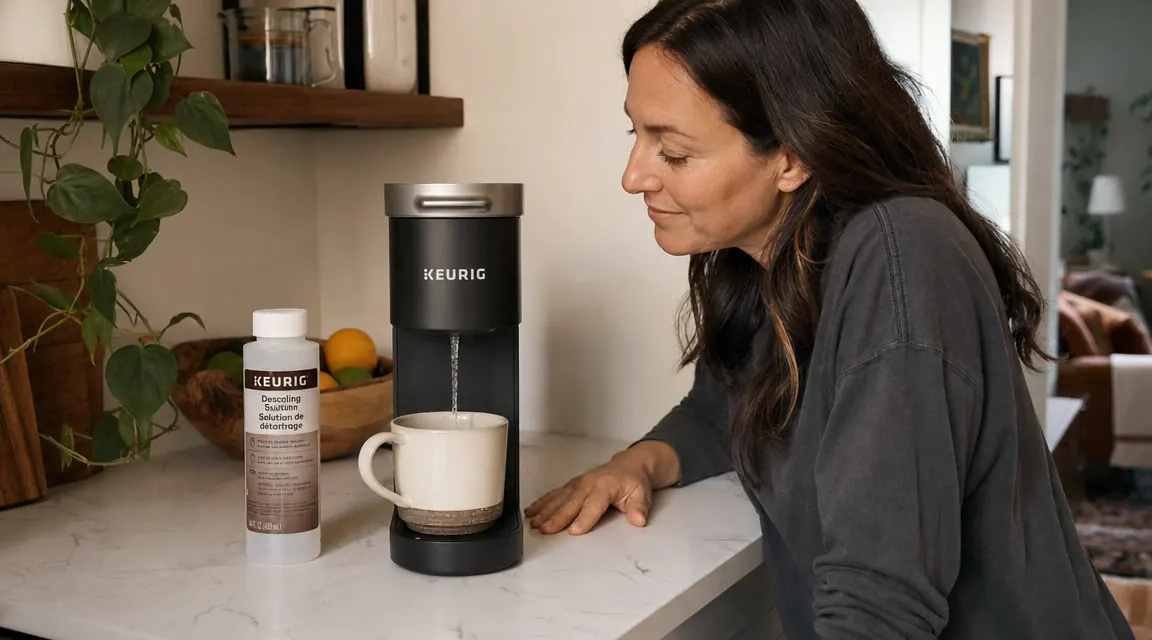
The K-Mini will remind you to descale it. The reminder light came on for me after about five weeks of daily use, which lines up with the roughly every-three-to-six-months guidance in the manual. Running the descaling cycle involves filling the reservoir with a mix of Keurig descaling solution and water, running it through without a pod, then running two full reservoirs of plain water through to rinse. The whole process takes about 45 minutes when you include the 30-minute soak the instructions ask for.
Keurig's own descaling solution costs around the mid-range for a two-use bottle. There are third-party options for less, and white vinegar works in a pinch. But the process itself is not instant, and the machine is unusable during it. If you have hard water, the mineral buildup happens faster and you will be doing this more often. My tap water is moderately hard and I needed to descale after about 150 cups. That is roughly every two to three months for a one-cup-per-day user. Budget for the descaling solution or find a vinegar-based alternative.
Machines that skip descaling or have easier maintenance cycles, like the AeroPress or a French press, have zero maintenance cost and zero downtime. I am not saying descaling is a dealbreaker, but a lot of reviewers treat it as a one-time thing and it is not.
What It Actually Does Well
None of the above means the K-Mini is a bad machine. It has a 5-by-4.5-inch footprint, which is genuinely tiny. It fits in corners where nothing else will. The cord wraps underneath the base, which is a smart design touch that keeps the counter cleaner. The machine heats and brews in under two minutes. It is dead simple to use: fill water, insert pod, press button, done. The build quality is solid, not cheap-feeling. The brew it produces at 6 oz is consistently acceptable, sometimes better than acceptable.
For a dorm room, an office desk, a small RV galley, or a studio where the coffee maker has to share a single square foot of counter with a toaster, this machine earns its space. The pod variety is enormous, which means you can rotate flavors or pick something seasonal without any investment in extra equipment. Cleanup is one wet rag on the drip tray every few days. It is not a machine with a learning curve. You do not need to dial in a grind size or figure out a water ratio. You press a button.
The cord storage is better than it sounds. Wrapped underneath, the cord disappears completely, which means the machine looks cleaner on the counter than most small appliances. That is a small thing but it matters in a tight space where every cord is visible.
What I Liked
- Footprint of just 5 by 4.5 inches, fits corners nothing else will
- Cord storage wraps neatly underneath the base
- Dead-simple operation, no settings to learn
- Wide K-Cup variety means easy flavor rotation
- Heats and brews in under two minutes
- Solid build quality, not flimsy
Where It Falls Short
- Must fill reservoir before every single cup, no shared tank
- Pod cost adds up to several hundred per year at two cups daily
- Brews at roughly 192 degrees, noticeably weak at 10-oz and 12-oz sizes
- Single-cup format is slow and awkward when guests are present
- No brew-strength setting on this model
- Descaling required every two to three months, takes 45 minutes
Who This Is For
The K-Mini fits one type of person very well: someone who lives alone, drinks one cup of coffee each morning, does not have strong feelings about brew temperature or coffee strength, and values counter space above almost everything else. If that is you, the K-Mini will probably serve you for years without complaint. The simplicity is a feature, not a compromise. You will not fuss with it. You will not overthink it. You will press a button and get coffee.
It also works well in secondary spaces where a full coffee setup does not belong: a home office nook, an RV, a guest bedroom, a break room with a single outlet and two feet of counter. Anywhere the goal is functional caffeine with zero footprint and zero thought.
Who Should Skip It
Skip the K-Mini if you drink two or more cups per morning and you want them quickly. The fill-every-cup design makes back-to-back brewing tedious in a way that feels like a chore by the third day. Skip it if you are budget-conscious about ongoing costs: the pod habit is real, and it is expensive compared to ground coffee. Skip it if you like your coffee strong or drink large mugs, because at 10-oz and 12-oz settings the output consistently disappoints.
If you share your kitchen with a partner or a roommate and you both drink coffee in the morning, get something else. A 4-cup drip brewer costs less than the K-Mini, brews four cups at once, and does not require you to stand in the kitchen running pods while the other person waits. The Nespresso Essenza Mini is worth comparing if you want espresso-strength coffee in the same compact footprint. If you want the full comparison, read the Keurig K-Mini vs Nespresso Essenza Mini side-by-side.
And if you are a light coffee drinker who just wants the occasional cup without a full setup, there is a real argument for a small pour-over dripper and a bag of pre-ground coffee. No machine to maintain, no pods to buy, no descaling cycle. The French press is even simpler. Neither takes up much room. Neither costs much every time you want a cup.
For more on how the K-Mini compares to other small-kitchen coffee options, the 10 reasons a single-serve coffee maker fits small kitchens article breaks down when the single-serve format makes sense and when it does not.
If the K-Mini fits your situation, it is worth checking today's price -- it goes on sale regularly
The K-Mini is the right machine for solo morning brewers who prioritize counter space above everything else. If that matches your setup, click through to see the current price and available colors.
Amazon Check Today's Price on Amazon →